
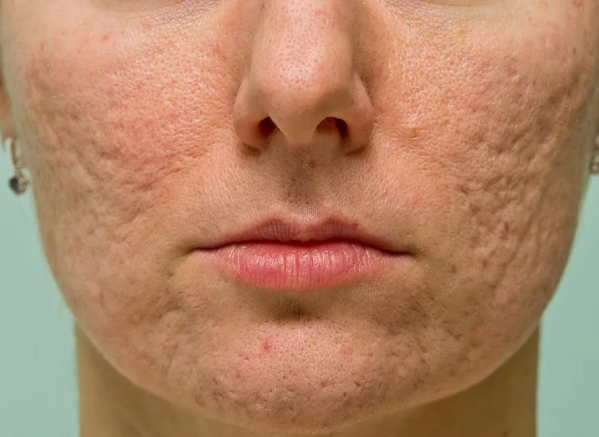
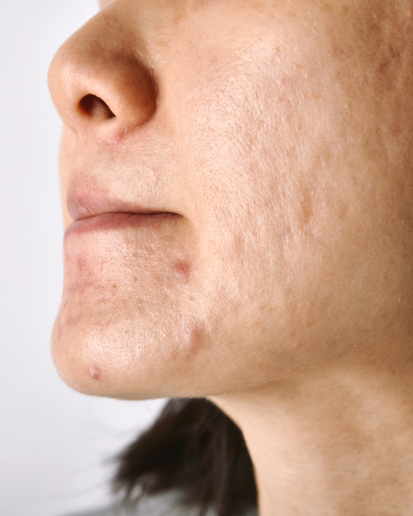
Acne affects us from adolescence onwards. Most cases of pubescent acne outbreaks are mild, self-limiting and do not leave scars. However, a proportion of individuals with moderate to serve acne may be left with permanent acne scars that can be associated with significant psychological distress. These emotional issues include anxiety, poor self-esteem, social phobia, and may at times appear far worse than the actual degree of acne scarring.
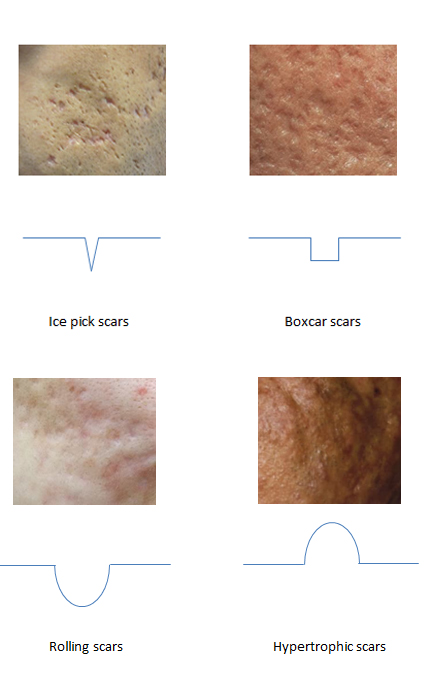
Like any form of scarring, acne scars represent a therapeutic challenge. The acne scars themselves are varied, ranging from shallow, deep, sharp-edged (boxcar), slope-edged (rolling), ice-pick (small and deep), atrophic (indented) and hypertrophic (raised) in appearance.
Consequently, there are a variety of treatment methods for acne scars:
All acne scar patients require a thorough pre-treatment assessment to reach a fully informed treatment plan.
For fractional resurfacing for acne scars, the treatment interval is about 1-3 months depending on the intensity. It is also crucial to manage patient expectations and to outline the approximate number of acne scar treatment sessions that may be necessary to reach the proposed end-point. Some patients believe acne scars can be easily treated and it is possible to regain their pre acne complexion. Patients need to understand that acne scar repair does not reverse acne scars, however it does improve their appearance by making them less noticeable.
Non-ablative fractional lasers such as 1550nm lasers are highly effective in healing scars and uneven skin colouring.They treat tiny micro columns of skin, allowing the untreated areas to help the recovery of the new skin, making it a much gentler process, with significantly reduced down-time. This procedure is most often applied as a series of five treatments with each treatment producing a noticeable improvement in the quality of the skin.
Ablative fractional laser treatment also known as Profractional / Fractional CO2 Resurfacing is excellent for treating severe acne scars. It is widely considered to be one of the most effective skin resurfacing techniques available. The main advantage is its reduced healing time. This procedure is most often applied over three treatments, with each treatment producing a noticeable improvement in skin quality. The laser stimulates underlying skin cells to trigger collagen production and break down scars.
Fractional Radiofrequency therapy has minimal recovery time and is suitable for patients of all skin colour and types. Fractional RF directly targets the collagen layer of the skin, breaking down scar tissues and promoting collagen remodelling and tightening. This procedure is most often applied as a series of five treatments, with each treatment producing a noticeable improvement in the quality of the skin.
Temporary fillers lasting 6-9 months can be injected as a micro-droplet into the base of indented scars to improve the scar contour. The filler is individually injected into most of the indented acne scars and can be combined with laser resurfacing and subcision (see below) for optimum results. Fillers for acne scars will not alter facial contour or shape. Scar fillers are popular for low-downtime scar improvement and to enhance final results after a course of fractional laser or radiofrequency treatments.
Subcision is a surgical technique that is utilised to release scars bound down to underlying tissue. This is performed under local anaesthetic and generally has no down time.
A focal chemical peel treatment to rejuvenate ice-pick acne scars. This is a weekend downtime procedure that helps shallow out pitted, deep acne scars over a series of treatments.